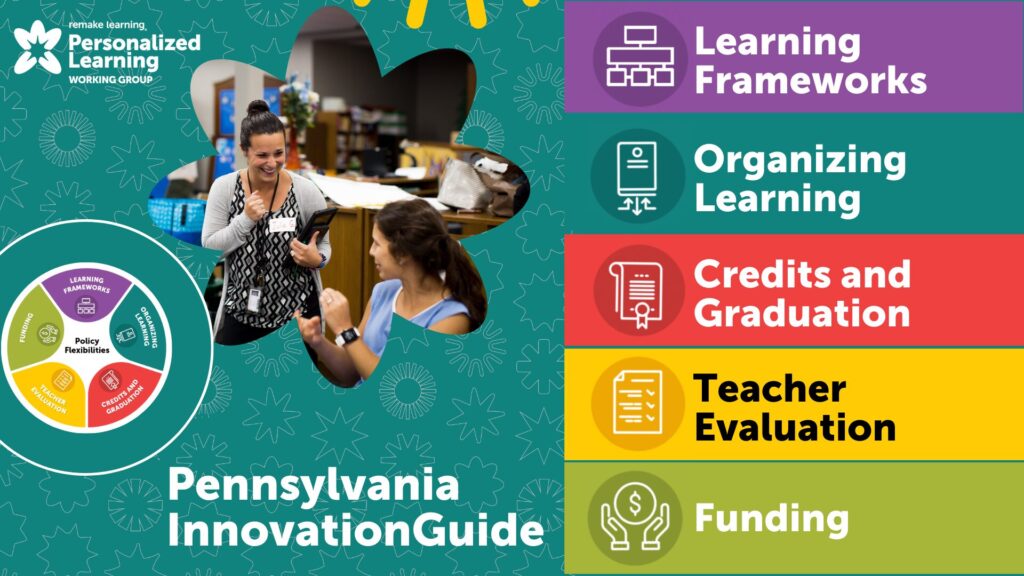
Want to initiate, scale or spread personalized learning at the classroom, school or district levels? Check out the Pennsylvania Innovation Guide.
To support education leaders in Pennsylvania, KnowledgeWorks in partnership with Remake Learning co-created this resource designed to help districts and schools take meaningful next steps toward personalization. The guide provides a clear understanding of Pennsylvania’s unique policy environment and highlights policy flexibilities available in the state to build systems that better serve all learners. The guide features local district spotlights along with theoretical examples to illustrate how policy can be leveraged to inspire shifts in mindset and catalyze systems transformation.
Ready to get started?
Exploring Areas of Influence
Before engaging with the guide, it can be helpful to consider different perspectives within the system. What goals are most important at the district, school, or classroom level, and how can personalized learning help achieve those goals?
Classroom Educators: Think about strategies that could be implemented within the classroom or across classrooms in partnership with other educators to make learning more relevant and connected to life beyond school. Eastern York School District, for example, demonstrates how to translate classroom learning into future-ready skills.The “Imagine If…” section in Resources and Partnerships might feel useful.
Building Principals: Focus on school structures, such as schedules and physical spaces, that lead to more personalized learning experiences. The Seneca Valley School district provides learners with what they refer to as “advanced experiences,” which allow learners to undergo independent studies overseen by an educator in areas about which they are passionate. Learners and educators collaborate to develop a plan, timeline and intended outcomes for the experience.
District Superintendents: Explore state policy flexibilities that could help jump-start or strengthen personalized learning initiatives. Northgate School District serves as a powerful example of how the state’s flexible instructional time policy helps learners gain valuable experiences outside of the traditional classroom. The Butler Area School District example showcases how local flexibilities allowed for the creation of an educator evaluation system that aligns to personalized learning values.
Navigating the Guide
This resource can be read cover to cover, or approached by specific sections depending on local priorities. Pages 1-8 provide helpful context about the guide’s development, purpose and content. Each area of the guide contains practical strategies for implementation across the K-12 spectrum:
- Profile of a Learner Creation – Supports schools and districts in building shared vision
- Resources and Partnerships – Offers community and cross-sector collaboration insights
- School Structure – Outlines ideas for reimagining learning environments
- Career-connected Learning – Explores opportunities that prepare learners for the future
- Professional Learning – Shares approaches to equipping educators for success
Synthesizing New Ideas Within Local Context
The guide features stories from districts that are leveraging personalized learning strategies to support students, as well as expert-informed hypothetical examples that demonstrate practical actions available to education leaders in Pennsylvania. Education leaders can reflect on:
- Which ideas or strategies align with local vision and goals?
- How do the examples from the guide build on or strengthen current work?
- What new ideas did the guide spark?
- Are any new approaches worth adopting or adapting?
Turning Ideas to Action
The ultimate goal of the guide is to help move schools and districts from ideas to action. As next steps are considered, it’s important to identify the barriers that might prevent implementation actions and identify the stakeholders and partners that could help overcome these obstacles.
Determining low-lift actions that can result in quick, yet significant wins, is a great place to start. Developing an action plan for implementation that includes known barriers, needed resources and potential partnerships can help ensure progress and long-term success. Often the most challenging step is just getting started! The innovation guide aims to make that first step clear and more achievable.
Download the Pennsylvania Innovation Guide

Authored by:

Emily Brixey
Senior Manager of Policy, Advocacy and Research
KnowledgeWorks

Lori Phillips
Senior Director of Teaching and Learning
KnowledgeWorks