Traditionally, many students spend their final year of high school taking a handful of required classes while waiting to leave for college, enter a trade or begin their job hunt. They hover in a holding pattern between their past and their future. For those unsure about what’s ahead, the first year after graduation can be a time of even more confusion — especially if they’re only familiar with the jobs they see in their own neighborhood.
But what if senior year could serve as a genuinely powerful launch pad? And what if the first year after high school could be a time of solid skill-building and community engagement for all students?
Today’s teens emerge from high school into an employment landscape that is shifting daily. Faced with so much uncertainty, many high school students are reluctant to commit to a career path or take on the significant student loan debt needed to achieve a career-required degree.
Data shows that only 61% of recent high school graduates enrolled in college in 2023, down from a pre-pandemic high of 70%. College costs have only risen since then.
To make the next steps after high school easier for today’s students, Remake Learning has awarded Moonshot Grants to two new programs that are designed to help Pittsburgh-area high school students rethink and prepare for their future possibilities.
These programs aim to ensure that all students can use their senior year and their first year beyond high school in ways that serve them well.
Reimagining 12th Grade: What if senior year was life’s first step, instead of school’s last?
Even in this moment of uncertainty, we know that there are essential skills — things like problem-solving, communicating, perseverance and collaborating with others — that help young people succeed in their careers and their personal lives.
We also know that teens can’t build a life that they don’t know exists. If they aren’t introduced to the wide range of jobs that exist beyond the borders of their neighborhood, they can’t begin pursuing those potentially fruitful paths.
Lastly, we know that students who earn college credits during high school are much more likely to pursue a college degree. And those who do meaningful internships and get hands-on job experience during high school are better positioned for success after graduation.
But traditionally, high schools haven’t offered all of this to most students.
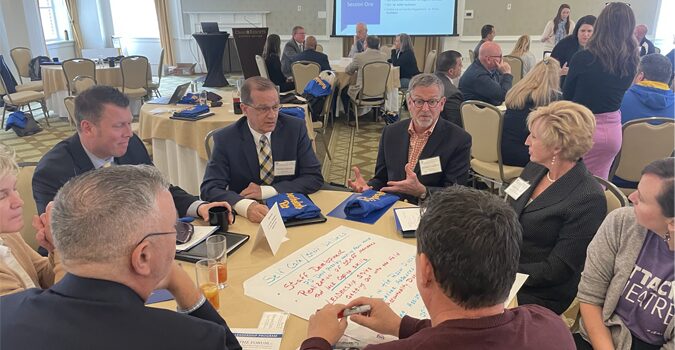
That’s why The Forum for Western Pennsylvania School Superintendents has spent the past year researching and designing a new approach to the 12th grade year. Working with six school districts located throughout southwestern PA, this Moonshot Grant-funded project has been exploring the benefits of combining mentoring with in-school and out-of-school learning to focus on essential skill development and social-emotional health.
“We were very deliberate in selecting schools that were from different parts of western PA and that had different profiles, because we don’t necessarily think there’s a one-size-fits all approach,” says Tom Ralston, executive director of the Forum. “Each community needs to determine what makes sense for them.”
It’s been a year of research and brainstorming for teams from Avonworth, Burrell, Butler Area, Cornell, Jeannette City and Peters Township. A mix of superintendents, assistant superintendents, principals and teachers from these districts have met in Pittsburgh and traveled together to explore innovative high school programming elsewhere in the country.
Each of these districts was already exploring new opportunities for their high schoolers. But, says Butler Area superintendent Dr. Brian White, it’s been valuable to share ideas with one another and “hear folks approach the same problems differently.”
Among the questions the cohort is exploring: What kinds of public/private partnerships would benefit students? White’s district has begun building a partnership with Butler Hospital and Butler Community College.
During the upcoming school year, 20 high schoolers will spend one day per week taking three classes at school that focus on things like first aid, CPR, hospital and medical terminology, and other aspects of health. Another day each week, they’ll spend the equivalent of three class periods at the hospital rotating through five departments, including phlebotomy and ambulatory care.
Each district is busy in their own ways reimagining courses that align to the state’s new career education standards, reinventing daily schedules to accommodate flex periods and internships, and connecting with various partners in their communities.
They’re also finding, Ralston says, that sometimes changing people’s mindsets about high school is the biggest challenge of all.
“Whether it’s teachers or students or parents, the stakes are pretty high: This is the end. This is where that transcript is finalized,” Ralston says. “Folks are very familiar with the traditional path of what this looks like. To change that sometimes requires people to get out of their comfort zone a little bit and think about the possibilities.”
Mind the Gap: What if a “gap year” could be a time of skill-building and community engagement?
The idea behind Mind the Gap percolated for years before the team at SLB Radio Productions applied for a Moonshot Grant. SLB has worked with high schoolers for decades, teaching them the skills of media-making and helping them share their voices.
Over time, SLB’s founder Larry Berger and his colleagues realized something: College-bound kids work with their school counselor to take the right courses and get some mentorship from teachers. Kids who have decided to learn a trade spend part of their school day with instructors at the local Career and Technical Center.
But what if you don’t know what’s next?
“Some students choose to take gap years. They know they want that,” says Berger. “There are often others who kind of surprisingly find themselves in a gap. Maybe a scholarship didn’t come through. They don’t know what comes next.”
Traditionally, these teens are on their own. “If you’re one of the ‘unintentional gap year’ people,” Berger says, “you really don’t have anyone to talk with about what you might do next.”
The idea for Mind the Gap began to grow after Berger spoke with a high school teacher who told him a story: A few years ago, she stopped at Subway for a sandwich. One of her former students — a recent grad — was behind the counter. “He told her, ‘I’m just doing this until I can figure out what to do next.’ Five years later, she still sees him there.”
With that in mind, Berger and SLB’s Jozef Kukula began to wonder: How do we create space for self-discovery and a sense of belonging among these students who aren’t on a specified path? Could gap-year students develop their own community of mutual support, networking and encouragement, and could they then help the next wave of high school grads join their fledgling community?
Exploring these questions, the SLB team found a lot of research reinforcing their sense that many young people feel lost and uncertain as they leave high school.
In the spring of 2025, the Mind the Gap fellowship was born.
Three high school seniors became the inaugural group of fellows. These students “didn’t want to go to college, but they really wanted to make something of this year,” Kukula says. “They were ambitious, but uncertain.”
They had applied to the program knowing it would give them each a $5,000 stipend and offer structure to what otherwise might have been a year spent floating alone. In turn, they would help design and build the program while serving as its first participants.
“We wanted to see what we could do to knock some doors open for them and connect them with people,” Kukula says. “But we also wanted them, as a trio, to bring together other young people to try to understand what this year could be.”
Since then, he says, “they’ve been living it and leading it.”
The fellows began regularly meeting together with the SLB team to explore an innovative question: How might they explore possible paths forward, while also supporting others who share their situation?
One answer: Hosting their own networking event for young people. They gained valuable skills while planning and managing the event, inviting employers to participate and helping teens who attended make the most of the opportunity.
They’ve also been documenting their own experiences and will soon begin visiting local high schools to talk with teens who are approaching graduation, Kukula says.
These students are still at the start of building their adult lives and careers. But this year they’ve made discoveries and built confidence.
One left high school a year ago dreaming of a career as a fashion entrepreneur. He’s now opted to take a full-time job that he’s excited about. Another is beginning a tech apprenticeship program. The third has done valuable personal exploration and begins this summer with new questions and new ideas.
For all three, the structure and support of the past year gave them a chance to move forward intentionally, surrounded by a growing community of their own making.
Meet the Storyteller
Melissa Rayworth
Melissa Rayworth is a writer for regional and global news outlets, and a communications consultant who works with people, foundations and companies to tease out and tell their stories across media.