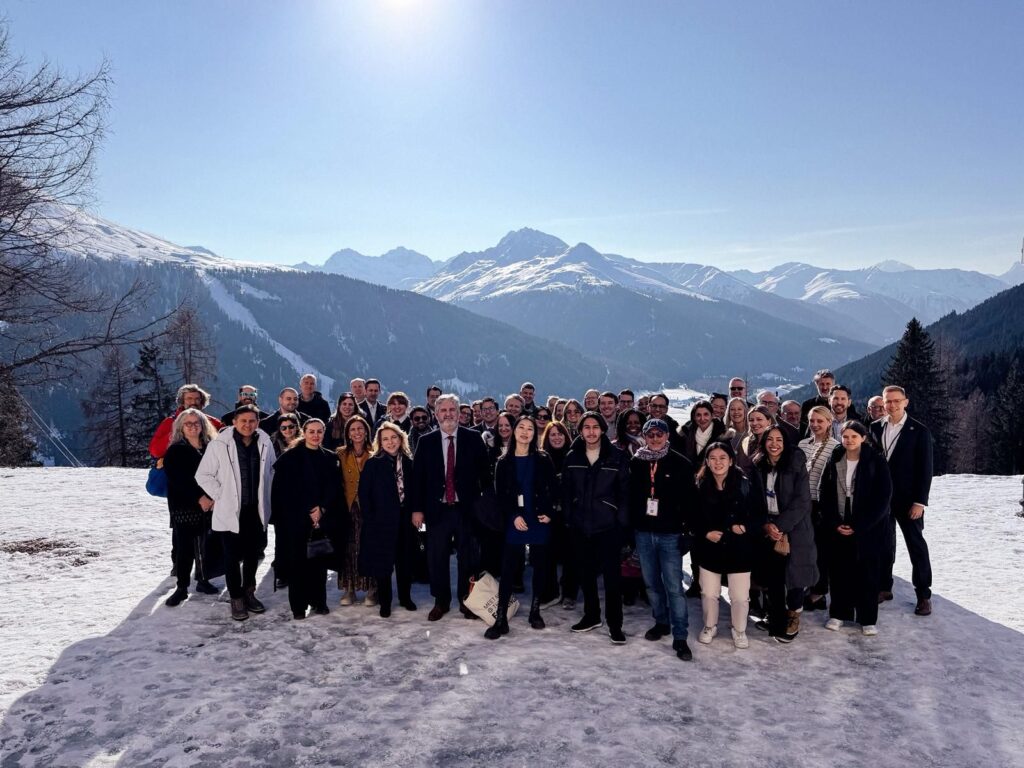
Each year, the World Economic Forum (WEF) hosts its annual meeting in the picturesque Swiss skiing village of Davos. World leaders who helm governments, businesses, civil organizations and academia gather for several days of official programming. Together, they grapple with global issues and speak on what they believe is ahead.
But the official programming at the WEF is only one venue where vital dialogue takes place. All along the main thoroughfare of this Alpine town, you can find “houses” hosted by nations, corporations and non-governmental organizations (NGOs), where some of the week’s most compelling discussions take place.
According to the WEF’s analysis, this year’s gathering drew a record number of political leaders — more than 400 from around the world — along with hundreds of CEOs. Many of them could be found at the houses, giving speeches and huddling with colleagues.
National houses have been described as “temporary embassies,” while corporate houses draw big names to their stages. This year, Oscar-winner Matt Damon spoke about his organization Water.org at Axios House, while Anthropic’s CEO Dario Amodei spoke about harnessing AI’s power at Bloomberg House.
Among the houses where vibrant discussion took place this year: Education House, co-convened by HundrED, JA Worldwide and Teach For All. Session partners included Dalberg, Education International, NFTE, SEK, ShiksaLokam, Teach Billions Fund and Villars Institute, and Pittsburgh’s Remake Learning.
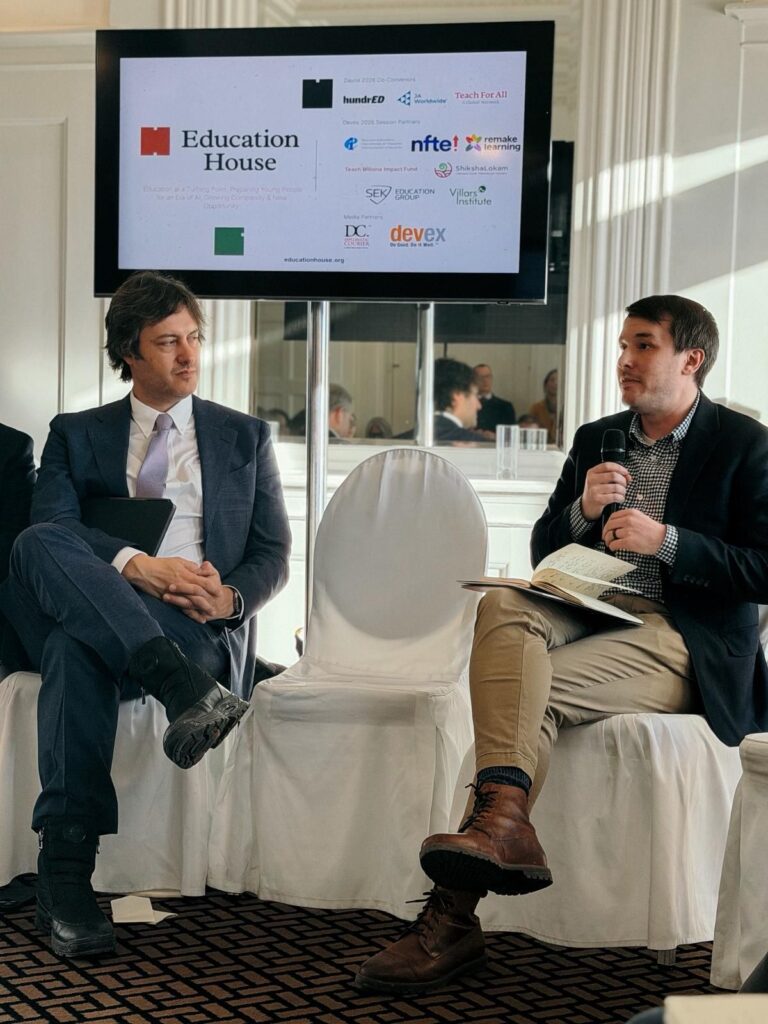
“The idea behind Education House events is to provide a space to share insights across sectors. In Davos, we brought together global decision makers and leaders to discuss how they see AI shaping the world in the coming years. The exponential speed of development creates a challenge for all systems, not just education,” said Lasse Leponiemi, co-founder and chairman of the HundrED Foundation.
“Many leaders expressed the need to focus on holistic learning and to think beyond subjects and the current understanding of needed competencies,” Leponiemi said. “As we see many entry-level jobs disappearing, we need to build pathways for youth to build meaningful lives — not just careers. Simultaneously, we need to understand contextuality.”
In an article written in the wake of this year’s WEF, Teach for All’s chief government officer Anna Molero wrote that “AI was everywhere. In nearly every conversation (about growth, education, health, climate or governance) AI surfaced as both promise and provocation. And yet, what struck me most wasn’t a sense that technology will replace humans, but almost the opposite.”
And yet, she wrote, “the more AI dominated the dialogue, the more attention turned to what cannot be automated: human judgment, trust, values, agency, relationships, and leadership. Again and again, people returned to the same realization: that the future will be shaped less by the tools we build and more by the people we become.”
Education House served as a valuable place to explore this realization and ask how best to can help the next generation truly thrive as people.
“I feel proud that we co-convened the inaugural Education House at Davos. Even at the margins, it mattered,” Molero said. “It created space to remind us that education is not a side issue, but a foundational one. That conversations about AI, inclusive growth, climate justice, and progress are incomplete without asking who we are equipping, how, and for what purpose.”
Two powerful sessions at Education House, each held in the round to facilitate open discussion, explored a key question: In a world where AI is suddenly ubiquitous, how does education need to evolve?
The first session, facilitated by Rebecca Winthrop, senior fellow and director of the Center for Universal Education at The Brookings Institution, and Asheesh Advani, president and CEO of JA Worldwide, opened with provocations offered by Winthrop and Wendy Kopp, CEO and co-founder of Teach For All.
Their message: We are now navigating — and we are shaping — a period of uncertainty. So when we think about this moment of rapid technological evolution, how do we come together across sectors to design around this new technology? That concept of coming together across sectors and working collaboratively to navigate uncertainty is very much embodied by the work of Remake Learning.
Winthrop spoke about the importance of human skills and human experiences, a theme that surfaced throughout formal and informal discussions at Davos this year, as Molero mentioned.
Many of today’s young people may have up to 20 different jobs that span multiple different careers during their lifetimes. With that in mind, what skills are they going to need? And how can educators wrestle with answering that question and figuring out how best to provide those skills?
The group discussed the reality that conventional K-12 schooling alone can’t shoulder the burden of teaching all those skills. Rather, communities will need an entire learning ecosystem — like the one we’re fostering here in the Pittsburgh region — where human, face-to-face learning experiences at museums, afterschool programs and so many other places, along with experiences at schools, will be the key to helping young people thrive.
How do we make school the most human experience that we can, Winthrop asked, and how might we ensure that the entire jigsaw puzzle of learning experiences in a child’s life is infused with human connection and memorable moments?
As attendees spoke about the ways their own organizations can play key roles in the jigsaw puzzle that is a diverse learning ecosystem, Remake Learning’s executive director, Tyler Samstag, explained that Remake Learning functions not like an individual piece but like the table that the puzzle sits upon.
It’s the stable base — the solid foundation — that allows all of the pieces to sit in connection to one another, ensuring that they can link up successfully.
“The thing that people most often struggle with, when I travel and speak about Remake Learning, is that they assume we must have a model of what it is that learning should look like. And then they assume we go in and help organizations conform to that. But that’s not us,” Samstag says. “We can create and start conversations about larger aspirations, but what that looks like is totally up to the organizations. It’s not up to us.”
As a presenter during the second session, which focused on how necessary multi-sector, public-private partnerships are today, Samstag spoke about what it really means to steward the kind of collective partnership that attendees were discussing.
What kinds of new roles are needed — people whose mission is to weave people together, convening and catalyzing, and serving as the connective tissue that fosters the kinds of collaboration that will create a robust menu of genuinely meaningful learning opportunities?
Along with conceiving of those new roles and bringing them to life, Samstag explained, it’s also vital to invest in the infrastructure that supports the work of those who populate a healthy learning ecosystem.
This is the work that Remake Learning has been doing for nearly 20 years: convening, catalyzing, communicating, championing and coordinating. In Davos this year, this global collection of thinkers agreed that these exact principles have never been more needed than they are today.
This communal approach is central to preparing young people for the rapidly evolving, AI-infused world we find ourselves navigating. Emphasizing that point, one presenter held up a recent copy of the Stanford Social Innovation Review to point out the cover story’s title: “The Future of Innovation Is Collective.”
And yet, just as Remake Learning doesn’t promote a single concept of what learning should look like or what a healthy learning ecosystem must contain, the most effective collaborations and solutions will be those uniquely designed and driven by individual communities.
“The needs differ from country to country, from system to system, and most importantly from learner to learner,” Leponiemi said. “For long-term stability and prosperity, we must prevent polarisation and strengthen weaker education systems in their development, so that these meaningful pathways are available for all youth, not only for learners in privileged countries. Every learner matters.”
Meet the Storyteller
Melissa Rayworth
Melissa Rayworth is a writer for regional and global news outlets, and a communications consultant who works with people, foundations and companies to tease out and tell their stories across media.